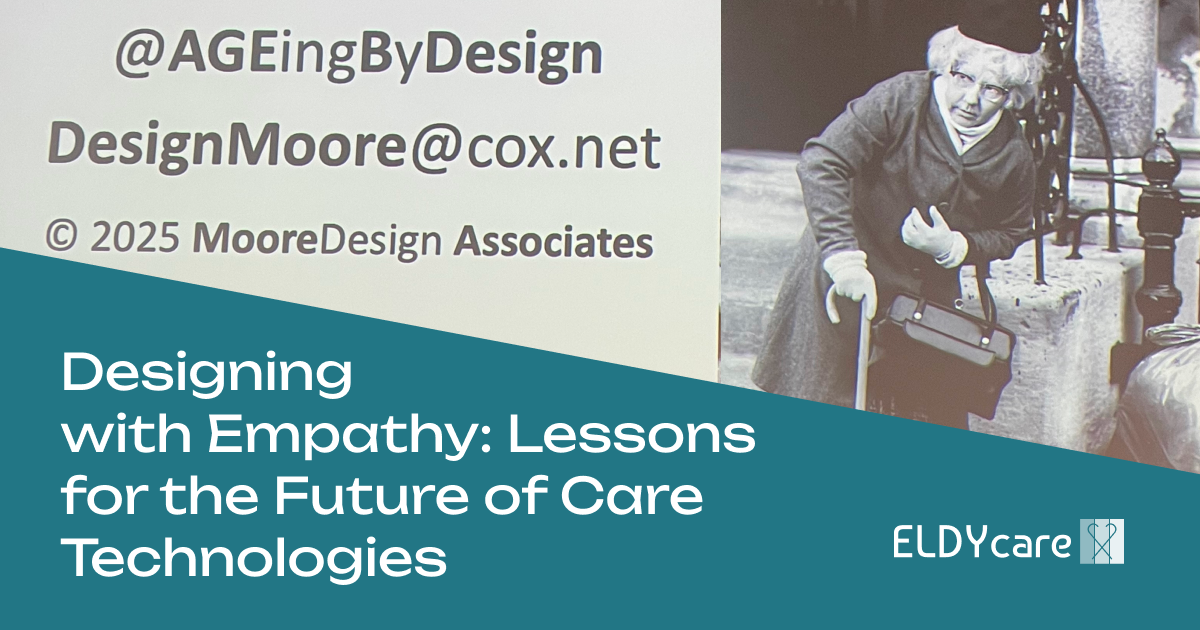
Last Tuesday, our colleague Geroli, Service Designer at ELDYcare, had the privilege of attending a lecture by Patricia Moore at the Estonian Academy of Art - a rare opportunity to learn from one of the true pioneers of user-centered design, and she is sharing her insights with us.
In the late 1970s, long before “empathy” became a buzzword in design, Patricia disguised herself as an elderly woman to experience firsthand the physical and social barriers older adults face daily. That radical act - wearing prosthetics that limited her vision, mobility, and dexterity - was not a stunt, but an act of deep research. It reshaped how the design world thinks about accessibility and gave birth to what we now call universal design. Patricia’s message was simple yet profound: “If the designer can’t use it - or their mother can’t - then the design has failed.” This idea feels particularly relevant to those of us working in social and care technology, where every design choice can either empower or alienate the people we aim to serve.
At Eldycare, we’re constantly reminded that designing for older adults or people with care needs isn’t just about convenience - it’s about dignity, independence, and belonging. Same principles apply when we are designing for the carers – people who have endless “to-do” list on their mind to provide quality care for their and our loved ones.
Key takeaways I’m bringing back to Eldycare:
Patricia’s resilience after decades of advocating for inclusion - often against indifference or cost-cutting mindsets - is a reminder that design is never neutral. Every decision we make is a choice: to exclude or to include, to ignore or to listen. Inclusion is not a buzzword - it is investing in society.
Inclusive design directly reduces care needs by enabling older adults and people with care needs to live more independently for longer. When homes, products, and digital tools are designed for accessibility, people need less assistance with daily activities, lowering both the visible and invisible costs of informal caregiving. It also delays or even prevents the need for institutional care - improving quality of life while easing the strain on families, communities, and social systems.
Inclusion, quite simply, pays off while reducing costs. As care technologies evolve, we face new challenges - from AI-driven tools to remote healthcare systems. But Patricia Moore’s lesson remains timeless: empathy is not a step in the process; it is the process. At Eldycare, we believe user-centered design isn’t optional - it’s the only way forward.
Geroli Peedu, Service Desginer, EDLYcare